2024 Latest PCNSA dumps Exam Material with 361 Questions
Palo Alto Networks PCNSA Questions and Answers Guarantee you Oass the Test Easily
Palo Alto Networks PCNSA (Palo Alto Networks Certified Network Security Administrator) Certification Exam is designed to validate the skills and knowledge required to manage and maintain the security of large enterprise networks. Palo Alto Networks Certified Network Security Administrator certification exam is intended for security professionals who are responsible for deploying, configuring, and managing Palo Alto Networks Next-Generation Firewalls (NGFWs). Palo Alto Networks Certified Network Security Administrator certification exam is conducted by Palo Alto Networks, a leading provider of network security solutions.
NEW QUESTION # 23
Which System log severity level would be displayed as a result of a user password change?
- A. Low
- B. Medium
- C. High
- D. Critical
Answer: A
Explanation:
System logs display entries for each system event on the firewall.
1. Critical - Hardware failures, including high availability (HA) failover and link failures.
2. High - Serious issues, including dropped connections with external devices, such as LDAP and RADIUS servers.
3. Medium - Mid-level notifications, such as antivirus package upgrades.
4. Low - Minor severity notifications, such as user password changes.
5. Informational - Log in/log off, administrator name or password change, any configuration change, and all other events not covered by the other severity levels.
https://docs.paloaltonetworks.com/pan-os/11-0/pan-os-admin/monitoring/view-and-manage-logs/log-types-and-severity-levels/system-logs#id8edbfdae-ed92-4d8e-ab76-6a38f96e8cb1
NEW QUESTION # 24
An administrator is reviewing another administrator s Security policy log settings.
Which log setting configuration is consistent with best practices tor normal traffic?
- A. Log at Session Start enabled Log at Session End disabled
- B. Log at Session Start disabled Log at Session End enabled
- C. Log at Session Start and Log at Session End both disabled
- D. Log at Session Start and Log at Session End both enabled
Answer: B
NEW QUESTION # 25
Place the steps in the correct packet-processing order of operations.
Answer:
Explanation:
NEW QUESTION # 26
You receive notification about new malware that infects hosts through malicious files transferred by FTP.
Which Security profile detects and protects your internal networks from this threat after you update your firewall's threat signature database?
- A. URL Filtering profile applied to inbound Security policy rules.
- B. Vulnerability Protection profile applied to outbound Security policy rules.
- C. Data Filtering profile applied to outbound Security policy rules.
- D. Antivirus profile applied to inbound Security policy rules.
Answer: D
Explanation:
https://docs.paloaltonetworks.com/pan-os/9-0/pan-os-admin/policy/security-profiles
NEW QUESTION # 27
Match the Palo Alto Networks Security Operating Platform architecture to its description.
Answer:
Explanation:
Explanation
Threat Intelligence Cloud - Gathers, analyzes, correlates, and disseminates threats to and from the network and endpoints located within the network.
Next-Generation Firewall - Identifies and inspects all traffic to block known threats Advanced Endpoint Protection - Inspects processes and files to prevent known and unknown exploits
NEW QUESTION # 28
Which three factors can be used to create malware based on domain generation algorithms?
(Choose three.)
- A. Time of day
- B. IP address
- C. Cryptographic keys
- D. URL custom categories
- E. Other unique values
Answer: A,C,E
Explanation:
https://docs.paloaltonetworks.com/pan-os/9-1/pan-os-admin/threat-prevention/dns- security/domain-generation-algorithm-detection
NEW QUESTION # 29
What in the minimum frequency for which you can configure the firewall too check for new wildfire antivirus signatures?
- A. every 30 minutes
- B. every 1 minute
- C. every 5 minutes
- D. every 24 hours
Answer: B
Explanation:
NEW QUESTION # 30
A server-admin in the USERS-zone requires SSH-access to all possible servers in all current and future Public Cloud environments. All other required connections have already been enabled between the USERS- and the OUTSIDE-zone. What configuration-changes should the Firewall-admin make?
- A. Create a custom-service-object called SERVICE-SSH for destination-port-TCP-22. Create a security-rule between zone USERS and OUTSIDE to allow traffic from any source IP-address to any destination IP- address for SERVICE-SSH
- B. In addition to option a, a custom-service-object called SERVICE-SSH-RETURN that contains source-port- TCP-22 should be created. A second security-rule is required that allows traffic from zone OUTSIDE to USERS for SERVICE-SSH-RETURN for any source-IP-address to any destination-Ip-address
- C. In addition to option c, an additional rule from zone OUTSIDE to USERS for application SSH from any source-IP-address to any destination-IP-address is required to allow the return-traffic from the SSH-servers to reach the server-admin
- D. Create a security-rule that allows traffic from zone USERS to OUTSIDE to allow traffic from any source IP- address to any destination IP-address for application SSH
Answer: D
Explanation:
Explanation/Reference:
NEW QUESTION # 31
What Policy Optimizer policy view differ from the Security policy do?
- A. It indicates that a broader rule matching the criteria is configured above a more specific rule.
- B. It shows rules that are missing Security profile configurations.
- C. It shows rules with the same Source Zones and Destination Zones.
- D. It indicates rules with App-ID that are not configured as port-based.
Answer: D
Explanation:
Policy Optimizer policy view differs from the Security policy view in several ways. One of them is that it indicates rules with App-ID that are not configured as port-based. These are rules that have the application set to "any" instead of a specific application or group of applications. These rules are overly permissive and can introduce security gaps, as they allow any application traffic on the specified ports. Policy Optimizer helps you convert these rules to application-based rules that follow the principle of least privilege access12. You can use Policy Optimizer to discover and convert port-based rules to application-based rules, and also to remove unused applications, eliminate unused rules, and discover new applications that match your policy criteria3. Reference:
Policy Optimizer Best Practices - Palo Alto Networks
Manage: Policy Optimizer - Palo Alto Networks | TechDocs
Why use Security Policy Optimizer and what are the benefits?
NEW QUESTION # 32
Which User-ID mapping method should be used for an environment with clients that do not authenticate to Windows Active Directory?
- A. passive server monitoring using a PAN-OS integrated User-ID agent
- B. Windows session monitoring via a domain controller
- C. Captive Portal
- D. passive server monitoring using the Windows-based agent
Answer: C
Explanation:
https://docs.paloaltonetworks.com/pan-os/9-0/pan-os-admin/user-id/map-ip-addresses-to-users/map-ip-addresses-to-usernames-using-captive-portal.html
NEW QUESTION # 33
Arrange the correct order that the URL classifications are processed within the system.
Answer:
Explanation:
Explanation
First - Block List
Second - Allow List
Third - Custom URL Categories
Fourth - External Dynamic Lists
Fifth - Downloaded PAN-DB Files
Sixth - PAN-DB Cloud
NEW QUESTION # 34
Which profile should be used to obtain a verdict regarding analyzed files?
- A. Vulnerability profile
- B. Content-ID
- C. Advanced threat prevention
- D. WildFire analysis
Answer: D
NEW QUESTION # 35
Match the Cyber-Attack Lifecycle stage to its correct description.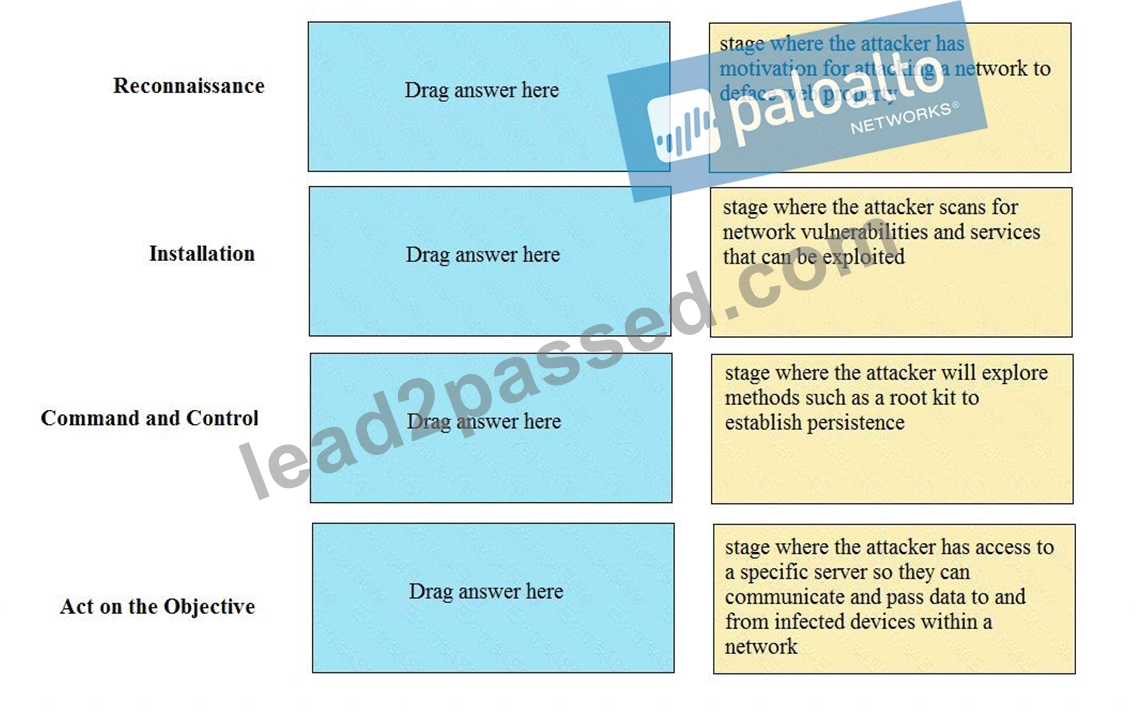
Answer:
Explanation:
Explanation:
Reconnaissance - stage where the attacker scans for network vulnerabilities and services that can be exploited.
Installation - stage where the attacker will explore methods such as a root kit to establish persistence Command and Control - stage where the attacker has access to a specific server so they can communicate and pass data to and from infected devices within a network.
Act on the Objective - stage where an attacker has motivation for attacking a network to deface web property
NEW QUESTION # 36
An administrator is implementing an exception to an external dynamic list by adding an entry to the list manually. The administrator wants to save the changes, but the OK button is grayed out.
What are two possible reasons the OK button is grayed out? (Choose two.)
- A. The entry matches a list entry.
- B. The entry contains wildcards.
- C. The entry doesn't match a list entry.
- D. The entry is duplicated.
Answer: C,D
NEW QUESTION # 37
Which Palo Alto Networks service protects cloud-based applications such as Dropbox and Salesforce by monitoring permissions and shares and scanning files for sensitive information?
- A. AutoFocus
- B. GlobalProtect
- C. Prisma SaaS
- D. Panorama
Answer: C
Explanation:
Explanation/Reference:
NEW QUESTION # 38
A security administrator has configured App-ID updates to be automatically downloaded and installed. The company is currently using an application identified by App-ID as SuperApp_base.
On a content update notice, Palo Alto Networks is adding new app signatures labeled SuperApp_chat and SuperApp_download, which will be deployed in 30 days.
Based on the information, how is the SuperApp traffic affected after the 30 days have passed?
- A. No impact because the apps were automatically downloaded and installed
- B. All traffic matching the SuperApp_base, SuperApp_chat, and SuperApp_download is denied until the security administrator approves the applications
- C. All traffic matching the SuperApp_chat, and SuperApp_download is denied because it no longer matches the SuperApp-base application
- D. No impact because the firewall automatically adds the rules to the App-ID interface
Answer: D
NEW QUESTION # 39
An administrator would like to use App-ID's deny action for an application and would like that action updated with dynamic updates as new content becomes available.
Which security policy action causes this?
- A. Drop
- B. Reset server
- C. Deny
- D. Reset both
Answer: C
Explanation:
Explanation/Reference:
Reference:
https://docs.paloaltonetworks.com/pan-os/8-1/pan-os-admin/firewall-administration/manage- configuration backups/revert-firewall-configuration- changes.html
NEW QUESTION # 40
Which URL Filtering Profile action does not generate a log entry when a user attempts to access a URL?
- A. block
- B. continue
- C. override
- D. allow
Answer: D
NEW QUESTION # 41
Which statement best describes a common use of Policy Optimizer?
- A. Policy Optimizer can display which Security policies have not been used in the last 90 days
- B. Policy Optimizer on a VM-50 firewall can display which Layer 7 App-ID Security policies have unused applications
- C. Policy Optimizer can add or change a Log Forwarding profile for each Security policy selected.
- D. Policy Optimizer can be used on a schedule to automatically create a disabled Layer 7 App-ID Security policy for every Layer 4 policy that exists Admins can then manually enable policies they want to keep and delete ones they want to remove
Answer: A
Explanation:
https://docs.paloaltonetworks.com/prisma/prisma-access/prisma-access-cloud-managed- admin/create-prisma-access-policy/policy-optimizer
NEW QUESTION # 42
Order the steps needed to create a new security zone with a Palo Alto Networks firewall.
Answer:
Explanation: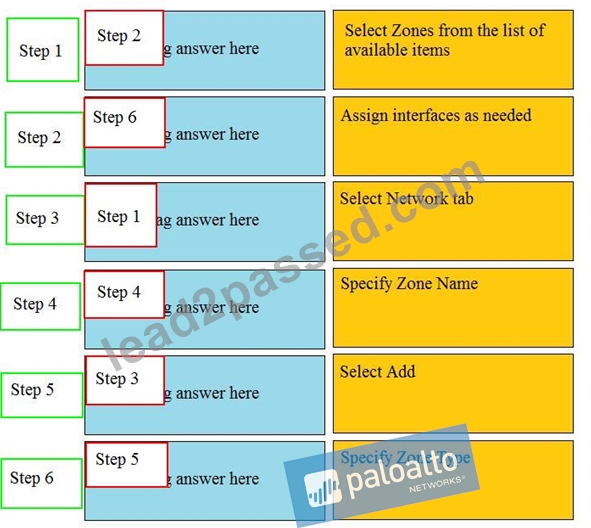
NEW QUESTION # 43
Which stage of the cyber-attack lifecycle makes it important to provide ongoing education to users on spear phishing links, unknown emails, and risky websites?
- A. exploitation
- B. reconnaissance
- C. delivery
- D. installation
Answer: C
Explanation:
Weaponization and Delivery: Attackers will then determine which methods to use in order to deliver malicious payloads. Some of the methods they might utilize are automated tools, such as exploit kits, spear phishing attacks with malicious links, or attachments and malvertizing. Gain full visibility into all traffic, including SSL, and block high-risk applications. Extend those protections to remote and mobile devices.
Protect against perimeter breaches by blocking malicious or risky websites through URL filtering. Block known exploits, malware and inbound command-and- control communications using multiple threat prevention disciplines, including IPS, anti-malware, anti-CnC, DNS monitoring and sinkholing, and file and content blocking.
Detect unknown malware and automatically deliver protections globally to thwart new attacks. Provide ongoing education to users on spear phishing links, unknown emails, risky websites, etc.
https://www.paloaltonetworks.com/cyberpedia/how-to-break-the-cyber-attack-lifecycle
NEW QUESTION # 44
What is the default action for the SYN Flood option within the DoS Protection profile?
- A. Sinkhole
- B. Random Early Drop
- C. Alert
- D. Reset-client
Answer: B
Explanation:
Random Early Drop -The firewall uses an algorithm to progressively start dropping that type of packet. If the attack continues, the higher the incoming cps rate (above the Activate Rate) gets, the more packets the firewall drops. ..
(https://docs.paloaltonetworks.com/pan-os/9-1/pan-os-admin/zone-protection-and-dos-protection/dos-protection-
NEW QUESTION # 45
Which statement best describes the use of Policy Optimizer?
- A. Policy Optimizer can display which Security policies have not been used in the last 90 days
- B. Policy Optimizer on a VM-50 firewall can display which Layer 7 App-ID Security policies have unused applications
- C. Policy Optimizer can add or change a Log Forwarding profile for each Secunty policy selected
- D. Policy Optimizer can be used on a schedule to automatically create a disabled Layer 7 App-ID Security policy for every Layer 4 policy that exists Admins can then manually enable policies they want to keep and delete ones they want to remove
Answer: B
NEW QUESTION # 46
Arrange the correct order that the URL classifications are processed within the system.
Answer:
Explanation:
NEW QUESTION # 47
Your company occupies one floor in a single building. You have two Active Directory domain controllers on a single network. The firewall's management plane is only slightly utilized.
Which User-ID agent is sufficient in your network?
- A. Windows-based agent deployed on the internal network a domain member
- B. PAN-OS integrated agent deployed on the firewall
- C. Windows-based agent deployed on each domain controller
- D. Citrix terminal server agent deployed on the network
Answer: C
Explanation:
https://docs.paloaltonetworks.com/pan-os/8-1/pan-os-admin/user-id/map-ip-addresses-to-users/configure-user-mapping-using-the-windows-user-id-agent/ configure-the-windows-based-user-id-agent-for-user-mapping.html
NEW QUESTION # 48
......
Share Latest PCNSA DUMP Questions and Answers: https://examsdocs.lead2passed.com/Palo-Alto-Networks/PCNSA-practice-exam-dumps.html