CSSLP Actual Questions Answers Pass With Real CSSLP Exam Dumps
CSSLP Dumps Prepare Your Exam With 349 Questions
NEW QUESTION # 39
Which of the following is a standard that sets basic requirements for assessing the effectiveness of computer security controls built into a computer system?
- A. FITSAF
- B. TCSEC
- C. FIPS
- D. SSAA
Answer: B
Explanation:
Trusted Computer System Evaluation Criteria (TCSEC) is a United States Government Department of Defense (DoD) standard that sets basic requirements for assessing the effectiveness of computer security controls built into a computer system. TCSEC was used to evaluate, classify, and select computer systems being considered for the processing, storage, and retrieval of sensitive or classified information. It was replaced with the development of the Common Criteria international standard originally published in 2005. The TCSEC, frequently referred to as the Orange Book, is the centerpiece of the DoD Rainbow Series publications. Answer D is incorrect. System Security Authorization Agreement (SSAA) is an information security document used in the United States Department of Defense (DoD) to describe and accredit networks and systems. The SSAA is part of the Department of Defense Information Technology Security Certification and Accreditation Process, or DITSCAP (superseded by DIACAP). The DoD instruction (issues in December 1997, that describes DITSCAP and provides an outline for the SSAA document is DODI 5200.40. The DITSCAP application manual (DoD 8510.1- M), published in July 2000, provides additional details. Answer A is incorrect. FITSAF stands for Federal Information Technology Security Assessment Framework. It is a methodology for assessing the security of information systems. It provides an approach for federal agencies. It determines how federal agencies are meeting existing policy and establish goals. The main advantage of FITSAF is that it addresses the requirements of Office of Management and Budget (OMB). It also addresses the guidelines provided by the National Institute of Standards and Technology (NIsT). Answer B is incorrect. The Federal Information Processing Standards (FIPS) are publicly announced standards developed by the United States federal government for use by all non-military government agencies and by government contractors. Many FIPS standards are modified versions of standards used in the wider community (ANSI, IEEE, ISO, etc.). Some FIPS standards were originally developed by the U.S. government. For instance, standards for encoding data (e.g., country codes), but more significantly some encryption standards, such as the Data Encryption Standard (FIPS 46-3) and the Advanced Encryption Standard (FIPS 197). In 1994, NOAA (Noaa) began broadcasting coded signals called FIPS (Federal Information Processing System) codes along with their standard weather broadcasts from local stations. These codes identify the type of emergency and the specific geographic area (such as a county) affected by the emergency.
NEW QUESTION # 40
Which of the following penetration testing techniques automatically tests every phone line in an exchange and tries to locate modems that are attached to the network?
- A. Sniffing
- B. Demon dialing
- C. Dumpster diving
- D. Social engineering
Answer: B
Explanation:
The demon dialing technique automatically tests every phone line in an exchange and tries to locate modems that are attached to the network. Information about these modems can then be used to attempt external unauthorized access. Answer B is incorrect. In sniffing, a protocol analyzer is used to capture data packets that are later decoded to collect information such as passwords or infrastructure configurations. Answer D is incorrect. Dumpster diving technique is used for searching paper disposal areas for unshredded or otherwise improperly disposed-of reports. Answer C is incorrect. Social engineering is the most commonly used technique of all, getting information (like passwords) just by asking for them.
NEW QUESTION # 41
Which of the following NIST Special Publication documents provides a guideline on questionnaires and checklists through which systems can be evaluated for compliance against specific control objectives?
- A. NIST SP 800-53A
- B. NIST SP 800-26
- C. NIST SP 800-37
- D. NIST SP 800-59
- E. NIST SP 800-60
- F. NIST SP 800-53
Answer: B
Explanation:
Explanation/Reference:
Explanation: NIST SP 800-26 (Security Self-Assessment Guide for Information Technology Systems) provides a guideline on questionnaires and checklists through which systems can be evaluated for compliance against specific control objectives. AnswerA, E, C, D, and F are incorrect. NIST has developed a suite of documents for conducting Certification & Accreditation (C&A). These documents are as follows:
NIST Special Publication 800-37: This document is a guide for the security certification and accreditation of Federal Information Systems. NIST Special Publication 800-53: This document provides a guideline for security controls for Federal Information Systems. NIST Special Publication 800-53A. This document consists of techniques and procedures for verifying the effectiveness of security controls in Federal Information System. NIST Special Publication 800-59: This document is a guideline for identifying an information system as a National Security System. NIST Special Publication 800-60: This document is a guide for mapping types of information and information systems to security objectives and risk levels.
NEW QUESTION # 42
Which of the following governance bodies directs and coordinates implementations of the information security program?
- A. Business Unit Manager
- B. Senior Management
- C. Chief Information Security Officer
- D. Information Security Steering Committee
Answer: C
Explanation:
Chief Information Security Officer directs and coordinates implementations of the information security program. The governance roles and responsibilities are mentioned below in the table: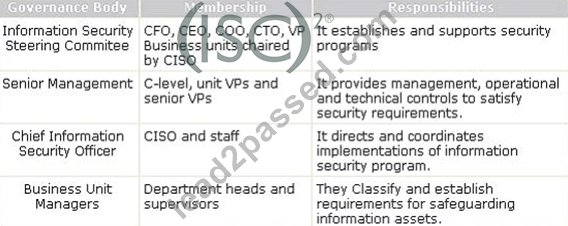
NEW QUESTION # 43
An assistant from the HR Department calls you to ask the Service Hours & Maintenance Slots for your ERP system. In which document will you most probably find this information?
- A. Service Level Requirements
- B. Release Policy
- C. Underpinning Contract
- D. Service Level Agreement
Answer: D
Explanation:
You will most probably find this information in the Service Level Agreement document. Amongst other information, SLA contains information about the agreed Service Hours and maintenance slots for any particular Service. Service Level Agreement (frequently abbreviated as SLA) is a part of a service contract where the level of service is formally defined. In practice, the term SLA is sometimes used to refer to the contracted delivery time (of the service) or performance. Service Level Agreement (SLA) is a negotiated agreement between two parties where one is the customer and the other is the service provider. This can be a legally binding formal or informal 'contract'. Contracts between the Service Provider and other third parties are often (incorrectly) called SLAs, as the level of service has been set by the (principal) customer there can be no 'agreement' between third parties (these agreements are simply a 'contract'). Operating Level Agreements or OLA(s) however, may be used by internal groups to support SLA (s). Answer B is incorrect. Release Policy is a set of rules for deploying releases into the live operational environment, defining different approaches for releases depending on their urgency and impact. Answer C is incorrect. The Service Level Requirements document contains the requirements for a service from the client viewpoint, defining detailed service level targets, mutual responsibilities, and other requirements specific to a certain group of customers. Answer D is incorrect. Underpinning Contract (UC) is a contract between an IT service provider and a third party. In another way, it is an agreement between the IT organization and an external provider about the delivery of one or more services. The third party provides services that support the delivery of a service to a customer. The Underpinning Contract defines targets and responsibilities that are required to meet agreed Service Level targets in an SLA.
NEW QUESTION # 44
Which of the following are the common roles with regard to data in an information classification program?
Each correct answer represents a complete solution. Choose all that apply.
- A. User
- B. Editor
- C. Owner
- D. Security auditor
- E. Custodian
Answer: A,C,D,E
Explanation:
Explanation/Reference:
Explanation: The following are the common roles with regard to data in an information classification program: Owner Custodian User Security auditor The following are the responsibilities of the owner with regard to data in an information classification program: Determining what level of classification the information requires. Reviewing the classification assignments at regular time intervals and making changes as the business needs change. Delegating the responsibility of the data protection duties to the custodian. The following are the responsibilities of the custodian with regard to data in an information classification program: Running regular backups and routinely testing the validity of the backup data Performing data restoration from the backups when necessary Controlling access, adding and removing privileges for individual users The users must comply with the requirements laid out in policies and procedures. They must also exercise due care. A security auditor examines an organization's security procedures and mechanisms.
NEW QUESTION # 45
The Information System Security Officer (ISSO) and Information System Security Engineer (ISSE) play the role of a supporter and advisor, respectively. Which of the following statements are true about ISSO and ISSE? Each correct answer represents a complete solution. Choose all that apply.
- A. An ISSE manages the security of the information system that is slated for Certification & Accreditation (C&A).
- B. An ISSE provides advice on the impacts of system changes.
- C. An ISSO takes part in the development activities that are required to implement system changes.
- D. An ISSE provides advice on the continuous monitoring of the information system.
- E. An ISSO manages the security of the information system that is slated for Certification & Accreditation (C&A).
Answer: B,D,E
Explanation:
Explanation/Reference:
Explanation: An Information System Security Officer (ISSO) plays the role of a supporter. The responsibilities of an Information System Security Officer (ISSO) are as follows: Manages the security of the information system that is slated for Certification & Accreditation (C&A). Insures the information systems configuration with the agency's information security policy. Supports the information system owner/information owner for the completion of security-related responsibilities. Takes part in the formal configuration management process. Prepares Certification & Accreditation (C&A) packages. An Information System Security Engineer (ISSE) plays the role of an advisor. The responsibilities of an Information System Security Engineer are as follows:
Provides view on the continuous monitoring of the information system. Provides advice on the impacts of system changes. Takes part in the configuration management process. Takes part in the development activities that are required to implement system changes. Follows approved system changes.
NEW QUESTION # 46
What are the various phases of the Software Assurance Acquisition process according to the U.S. Department of Defense (DoD) and Department of Homeland Security (DHS) Acquisition and Outsourcing Working Group?
- A. Requirements, planning, monitoring, auditing
- B. Implementing, contracting, auditing, monitoring
- C. Designing, implementing, contracting, monitoring
- D. Planning, contracting, monitoring and acceptance, follow-on
Answer: D
Explanation:
Software Assurance Acquisition process defines the level of confidence that software is free from vulnerabilities. It is designed into the software or accidentally inserted at anytime during its lifecycle, and the software works in a planned manner. According to the U.S. Department of Defense and Department of Homeland Security Acquisition and Outsourcing Working Group, the Software Assurance Acquisition process contains the following phases: 1.Planning 2.Contracting 3.Monitoring and acceptance 4.Follow-on
NEW QUESTION # 47
You are the project manager for a construction project. The project involves casting of a column in a very narrow space. Because of lack of space, casting it is highly dangerous. High technical skill will be required for casting that column. You decide to hire a local expert team for casting that column. Which of the following types of risk response are you following?
- A. Acceptance
- B. Transference
- C. Mitigation
- D. Avoidance
Answer: B
Explanation:
According to the question, you are hiring a local expert team for casting the column. As you have transferred your risk to a third party, this is the transference risk response that you have adopted. Transference is a strategy to mitigate negative risks or threats. In this strategy, consequences and the ownership of a risk is transferred to a third party. This strategy does not eliminate the risk but transfers responsibility of managing the risk to another party. Insurance is an example of transference. Answer C is incorrect. Mitigation is a risk response planning technique associated with threats that seeks to reduce the probability of occurrence or impact of a risk to below an acceptable threshold. Risk mitigation involves taking early action to reduce the probability and impact of a risk occurring on the project. Adopting less complex processes, conducting more tests, or choosing a more stable supplier are examples of mitigation actions. Answer A is incorrect. Avoidance involves changing the project management plan to eliminate the threat entirely. Answer B is incorrect. Acceptance response is a part of Risk Response planning process. Acceptance response delineates that the project plan will not be changed to deal with the risk. Management may develop a contingency plan if the risk does occur. Acceptance response to a risk event is a strategy that can be used for risks that pose either threats or opportunities. Acceptance response can be of two types: Passive acceptance: It is a strategy in which no plans are made to try or avoid or mitigate the risk. Active acceptance: Such responses include developing contingency reserves to deal with risks, in case they occur. Acceptance is the only response for both threats and opportunities.
NEW QUESTION # 48
Fred is the project manager of the CPS project. He is working with his project team to prioritize the identified risks within the CPS project. He and the team are prioritizing risks for further analysis or action by assessing and combining the risks probability of occurrence and impact. What process is Fred completing?
- A. Risk identification
- B. Perform qualitative analysis
- C. Risk Breakdown Structure creation
- D. Perform quantitative analysis
Answer: B
Explanation:
Explanation/Reference:
Explanation: Qualitative ranks the probability and impact and then helps the project manager and team to determine which risks need further analysis. Perform Qualitative Risk Analysis is the process of prioritizing risks for further analysis and action. It combines risks and their probability of occurrences and ranks them accordingly. It enables organizations to improve the project's performance by focusing on high-priority risks. Perform Qualitative Risk Analysis is usually a rapid and cost-effective means of establishing priorities for Plan Risk Responses. It also lays the foundation for Perform Quantitative Risk Analysis. AnswerA is incorrect. Risk identification precedes this activity. Answer: B is incorrect. This process does not describe the decomposition and organization of risks that you will complete in a risk breakdown structure.
AnswerD is incorrect. Quantitative analysis is the final step of risk analysis. Note the question tells you
that Fred and the team will identify risks for additional analysis.
NEW QUESTION # 49
FITSAF stands for Federal Information Technology Security Assessment Framework. It is a methodology for assessing the security of information systems. Which of the following FITSAF levels shows that the procedures and controls are tested and reviewed?
- A. Level 5
- B. Level 4
- C. Level 1
- D. Level 3
- E. Level 2
Answer: B
Explanation:
Explanation/Reference:
Explanation: The following are the five levels of FITSAF based on SEI's Capability Maturity Model (CMM):
Level 1: The first level reflects that an asset has documented a security policy. Level 2: The second level shows that the asset has documented procedures and controls to implement the policy. Level 3: The third level indicates that these procedures and controls have been implemented. Level 4: The fourth level shows that the procedures and controls are tested and reviewed. Level 5: The fifth level is the final level and shows that the asset has procedures and controls fully integrated into a comprehensive program.
NEW QUESTION # 50
Which of the following security controls will you use for the deployment phase of the SDLC to build secure software? Each correct answer represents a complete solution. Choose all that apply.
- A. Change and Configuration Control
- B. Risk Adjustments
- C. Security Certification and Accreditation (C&A)
- D. Vulnerability Assessment and Penetration Testing
Answer: B,C,D
Explanation:
The various security controls in the SDLC deployment phase are as follows: Secure Installation: While performing any software installation, it should kept in mind that the security configuration of the environment should never be reduced. If it is reduced then security issues and overall risks can affect the environment. Vulnerability Assessment and Penetration Testing: Vulnerability assessments (VA) and penetration testing (PT) is used to determine the risk and attest to the strength of the software after it has been deployed. Security Certification and Accreditation (C&A): Security certification is the process used to ensure controls which are effectively implemented through established verification techniques and procedures, giving organization officials confidence that the appropriate safeguards and countermeasures are in place as means of protection. Accreditation is the provisioning of the necessary security authorization by a senior organization official to process, store, or transmit information. Risk Adjustments: Contingency plans and exceptions should be generated so that the residual risk be above the acceptable threshold.
NEW QUESTION # 51
Which of the following disaster recovery tests includes the operations that shut down at the primary site, and are shifted to the recovery site according to the disaster recovery plan?
- A. Structured walk-through test
- B. Full-interruption test
- C. Simulation test
- D. Parallel test
Answer: B
Explanation:
A full-interruption test includes the operations that shut down at the primary site and are shifted to the recovery site according to the disaster recovery plan. It operates just like a parallel test. The full-interruption test is very expensive and difficult to arrange. Sometimes, it causes a major disruption of operations if the test fails. Answer A is incorrect. The structured walk-through test is also known as the table-top exercise. In structured walk-through test, the team members walkthrough the plan to identify and correct weaknesses and how they will respond to the emergency scenarios by stepping in the course of the plan. It is the most effective and competent way to identify the areas of overlap in the plan before conducting more challenging training exercises. Answer C is incorrect. A parallel test includes the next level in the testing procedure, and relocates the employees to an alternate recovery site and implements site activation procedures. These employees present with their disaster recovery responsibilities as they would for an actual disaster. The disaster recovery sites have full responsibilities to conduct the day-to-day organization's business. Answer D is incorrect. A simulation test is a method used to test the disaster recovery plans. It operates just like a structured walk- through test. In the simulation test, the members of a disaster recovery team present with a disaster scenario and then, discuss on appropriate responses. These suggested responses are measured and some of them are taken by the team. The range of the simulation test should be defined carefully for avoiding excessive disruption of normal business activities.
NEW QUESTION # 52
Which of the following is a chronological record of system activities to enable the reconstruction and examination of the sequence of events and/or changes in an event?
- A. Detective controls
- B. Audit trail
- C. Security audit
- D. Explanation:
Audit trail or audit log is a chronological sequence of audit records, each of which contains evidence directly pertaining to and resulting from the execution of a business process or system function. Audit records typically result from activities such as transactions or communications by individual people, systems, accounts, or other entities. The process that creates audit trail should always run in a privileged mode, so it could access and supervise all actions from all users, and normal user could not stop/change it. Furthermore, for the same reason, trail file or database table with a trail should not be accessible to normal users. Answer C is incorrect. A computer security audit is a manual or systematic measurable technical assessment of a system or application. Manual assessments include interviewing staff, performing security vulnerability scans, reviewing application and operating system access controls, and analyzing physical access to the systems. Automated assessments, or CAAT's, include system generated audit reports or using software to monitor and report changes to files and settings on a system. Systems can include personal computers, servers, mainframes, network routers, and switches. - E. Corrective controls
Answer: B
Explanation:
is incorrect. Detective controls are the audit controls that are not needed to be restricted. Any control that performs a monitoring activity can likely be defined as a Detective Control. For example, it is possible that mistakes, either intentional or unintentional, can be made. Therefore, an additional Protective control is that these companies must have their financial results audited by an independent Certified Public Accountant. The role of this accountant is to act as an auditor. In fact, any auditor acts as a Detective control. If the organization in question has not properly followed the rules, a diligent auditor should be able to detect the deficiency which indicates that some control somewhere has failed. Answer A is incorrect. Reactive or corrective controls typically work in response to a detective control, responding in such a way as to alert or otherwise correct an unacceptable condition. Using the example of account rules, either the internal Audit Committee or the SEC itself, based on the report generated by the external auditor, will take some corrective action. In this way, they are acting as a Corrective or Reactive control.
NEW QUESTION # 53
Copyright holders, content providers, and manufacturers use digital rights management (DRM) in order to limit usage of digital media and devices. Which of the following security challenges does DRM include? Each correct answer represents a complete solution. Choose all that apply.
- A. OTA provisioning
- B. Access control
- C. Device fingerprinting
- D. Key hiding
Answer: A,C,D
Explanation:
The security challenges for DRM are as follows: Key hiding: It prevents tampering attacks that target the secret keys. In the key hiding process, secret keys are used for authentication, encryption, and node-locking. Device fingerprinting: It prevents fraud and provides secure authentication. Device fingerprinting includes the summary of hardware and software characteristics in order to uniquely identify a device. OTA provisioning: It provides end-to-end encryption or other secure ways for delivery of copyrighted software to mobile devices. Answer B is incorrect. Access control is not a security challenge for DRM.
NEW QUESTION # 54
Which of the following terms refers to a mechanism which proves that the sender really sent a particular message?
- A. Integrity
- B. Authentication
- C. Non-repudiation
- D. Confidentiality
Answer: C
Explanation:
Non-repudiation is a mechanism which proves that the sender really sent a message. It provides an evidence of the identity of the senderand message integrity. It also prevents a person from denying the submission or delivery of the message and the integrity of its contents. Answer C is incorrect. Authentication is a process of verifying the identity of a person or network host. Answer A is incorrect. Confidentiality ensures that no one can read a message except the intended receiver. Answer D is incorrect. Integrity assures the receiver that the received message has not been altered in any way from the original.
NEW QUESTION # 55
Which of the following acts is used to recognize the importance of information security to the economic and national security interests of the United States?
- A. FISMA
- B. Lanham Act
- C. Computer Fraud and Abuse Act
- D. Computer Misuse Act
Answer: A
Explanation:
Explanation/Reference:
Explanation: The Federal Information Security Management Act of 2002 is a United States federal law enacted in 2002 as Title III of the E-Government Act of 2002. The act recognized the importance of information security to the economic and national security interests of the United States. The act requires each federal agency to develop, document, and implement an agency-wide program to provide information security for the information and information systems that support the operations and assets of the agency, including those provided or managed by another agency, contractor, or other source. FISMA has brought attention within the federal government to cybersecurity and explicitly emphasized a 'risk-based policy for cost-effective security'. FISMA requires agency program officials, chief information officers, and Inspectors Generals (IGs) to conduct annual reviews of the agency's information security program and report the results to Office of Management and Budget (OMB). OMB uses this data to assist in its oversight responsibilities and to prepare this annual report to Congress on agency compliance with the act. Answer:
B is incorrect. The Lanham Act is a piece of legislation that contains the federal statutes of trademark law in the United States. The Act prohibits a number of activities, including trademark infringement, trademark dilution, and false advertising. It is also called Lanham Trademark Act. AnswerA is incorrect. The Computer Misuse Act 1990 is an act of the UK Parliament which states the following statement:
Unauthorized access to the computer material is punishable by 6 months imprisonment or a fine "not exceeding level 5 on the standard scale" (currently 5000). Unauthorized access with the intent to commit or facilitate commission of further offences is punishable by 6 months/maximum fine on summary conviction or 5 years/fine on indictment. Unauthorized modification of computer material is subject to the same sentences as section 2 offences.
AnswerC is incorrect. The Computer Fraud and Abuse Act is a law passed by the United States
Congress in 1984 intended to reduce cracking of computer systems and to address federal computer- related offenses. The Computer Fraud and Abuse Act (codified as 18 U.S.C. 1030) governs cases with a compelling federal interest, where computers of the federal government or certain financial institutions are involved, where the crime itself is interstate in nature, or computers used in interstate and foreign commerce. It was amended in 1986, 1994, 1996, in 2001 by the USA PATRIOT Act, and in 2008 by the Identity Theft Enforcement and Restitution Act. Section (b) of the act punishes anyone who not just commits or attempts to commit an offense under the Computer Fraud and Abuse Act but also those who conspire to do so.
NEW QUESTION # 56
Which of the following types of obfuscation transformation increases the difficulty for a de-obfuscation tool so that it cannot extract the true application from the obfuscated version?
- A. Layout obfuscation
- B. Data obfuscation
- C. Control obfuscation
- D. Preventive transformation
Answer: D
Explanation:
Explanation/Reference:
Explanation: Preventive transformation increases the difficulty for a de-obfuscation tool so that it cannot extract the true application from the obfuscated version.
NEW QUESTION # 57
Which of the following recovery plans includes specific strategies and actions to deal with specific variances to assumptions resulting in a particular security problem, emergency, or state of affairs?
- A. Continuity of Operations Plan
- B. Disaster recovery plan
- C. Business continuity plan
- D. Contingency plan
Answer: D
Explanation:
A contingency plan is a plan devised for a specific situation when things could go wrong. Contingency plans include specific strategies and actions to deal with specific variances to assumptions resulting in a particular problem, emergency, or state of affairs. They also include a monitoring process and triggers for initiating planned actions. Answer A is incorrect. Disaster recovery is the process, policies, and procedures related to preparing for recovery or continuation of technology infrastructure critical to an organization after a natural or human-induced disaster. Answer B is incorrect. It deals with the plans and procedures that identify and prioritize the critical business functions that must be preserved. Answer C is incorrect. It includes the plans and procedures documented that ensure the continuity of critical operations during any period where normal operations are impossible.
NEW QUESTION # 58
Which of the following concepts represent the three fundamental principles of information security? Each correct answer represents a complete solution. Choose three.
- A. Availability
- B. Privacy
- C. Confidentiality
- D. Integrity
Answer: A,C,D
Explanation:
Explanation/Reference:
Explanation: The following concepts represent the three fundamental principles of information security:
1.Confidentiality 2.Integrity 3.Availability AnswerB is incorrect. Privacy, authentication, accountability, authorization and identification are also concepts related to information security, but they do not represent the fundamental principles of information security.
NEW QUESTION # 59
DoD 8500.2 establishes IA controls for information systems according to the Mission Assurance Categories (MAC) and confidentiality levels. Which of the following MAC levels requires high integrity and medium availability?
- A. MAC II
- B. MAC III
- C. MAC IV
- D. MAC I
Answer: A
Explanation:
The various MAC levels are as follows: MAC I: It states that the systems have high availability and high integrity. MAC II: It states that the systems have high integrity and medium availability. MAC III: It states that the systems have basic integrity and availability.
NEW QUESTION # 60
Which of the following DITSCAP phases validates that the preceding work has produced an IS that operates in a specified computing environment?
- A. Phase 1
- B. Phase 2
- C. Phase 4
- D. Phase 3
Answer: D
Explanation:
Explanation/Reference:
Explanation: The Phase 3 of DITSCAP C&A is known as Validation. The goal of Phase 3 is to validate that the preceding work has produced an IS that operates in a specified computing environment. AnswerC is incorrect. The goal of this phase is to define the C&A level of effort, identify the main C&A roles and responsibilities, and create an agreement on the method for implementing the security requirements.
AnswerA is incorrect. The goal of this phase is to obtain a fully integrated system for certification testing
and accreditation. AnswerB is incorrect. This phase ensures that it will maintain an acceptable level of residual risk.
NEW QUESTION # 61
......
Requirements
Those individuals pursuing the (ISC)2 CSSLP certification must have at least 4 years of cumulative and full-time work experience as a Software Development Lifecycle Professional. They must have practical experience in at least one of the eight domains of the CSSLP Common Book of Knowledge. The applicants with a four-year degree in the Information Technology, computer science, or other related fields with three years of full-time work experience in at least one of the eight domains can also opt for this certificate. Those candidates who do not possess this work experience can proceed to take the prerequisite exam and earn the Associate of (ISC)2 certification. They can gain the prerequisite years of experience within five years after obtaining this associate-level option to upgrade to CSSLP.
New CSSLP Dumps - Real ISC Exam Questions: https://examsdocs.lead2passed.com/ISC/CSSLP-practice-exam-dumps.html