Accurate Hot Selling ServSafe-Manager Exam Dumps 2026 Newly Released
Get 100% Authentic ServSafe ServSafe-Manager Dumps with Correct Answers
NEW QUESTION # 29
Which food must be stored at a temperature of 41°F (5°C) or lower?
- A. Cookies-and-brownies tray
- B. Fruit basket with uncut fruit
- C. Ham-and-cheese sandwich
- D. Beef jerky and cracker appetizers
Answer: C
Explanation:
According to the ServSafe Manager curriculum and the FDA Food Code, foods that require Time
/Temperature Control for Safety (TCS food) must be stored at an internal temperature of $41^{\circ}F$ ($5^
{\circ}C$) or lower to inhibit the growth of pathogenic bacteria. A ham-and-cheese sandwich is a prime example of a TCS food because it contains protein-rich ingredients (meat and dairy) that are moist and neutral or slightly acidic-the ideal environment for bacterial multiplication.
Ham is a processed meat that, while cured, still requires refrigeration to remain safe. Cheese is a dairy product that is also classified as a TCS food. When combined in a sandwich, the product becomes a "ready-to-eat" TCS food. If left in the Temperature Danger Zone-defined as the range between $41^{\circ}F$ and $135^
{\circ}F$ ($5^{\circ}C$ and $57^{\circ}C$)-bacteria such asStaphylococcus aureusorListeria monocytogenescan grow to dangerous levels. In contrast, beef jerky is a shelf-stable dried meat with low water activity ($a_w$), cookies and brownies are low-moisture baked goods, and uncut fruit (except for certain melons, tomatoes, and leafy greens once cut) is generally not considered a TCS food. Proper storage at
$41^{\circ}F$ or lower ensures that the sandwich remains safe for the duration of its shelf life, which is typically a maximum of seven days if prepared on-site. Managers must ensure that refrigerated storage units are calibrated and that the internal temperature of the food, not just the ambient air of the cooler, remains at or below the $41^{\circ}F$ threshold.
NEW QUESTION # 30
When should food handlers use hand antiseptics?
- A. After washing hands
- B. Instead of washing hands
- C. After putting on gloves
- D. Before washing hands
Answer: A
Explanation:
Hand antiseptics (hand sanitizers) are often misunderstood in the foodservice industry. According to the ServSafe Manager curriculum and the FDA Food Code, hand antiseptics arenever a substitute for handwashing. They must only be usedafterthe full handwashing process has been completed and the hands have been dried.
Image of handwashing vs. hand antiseptic use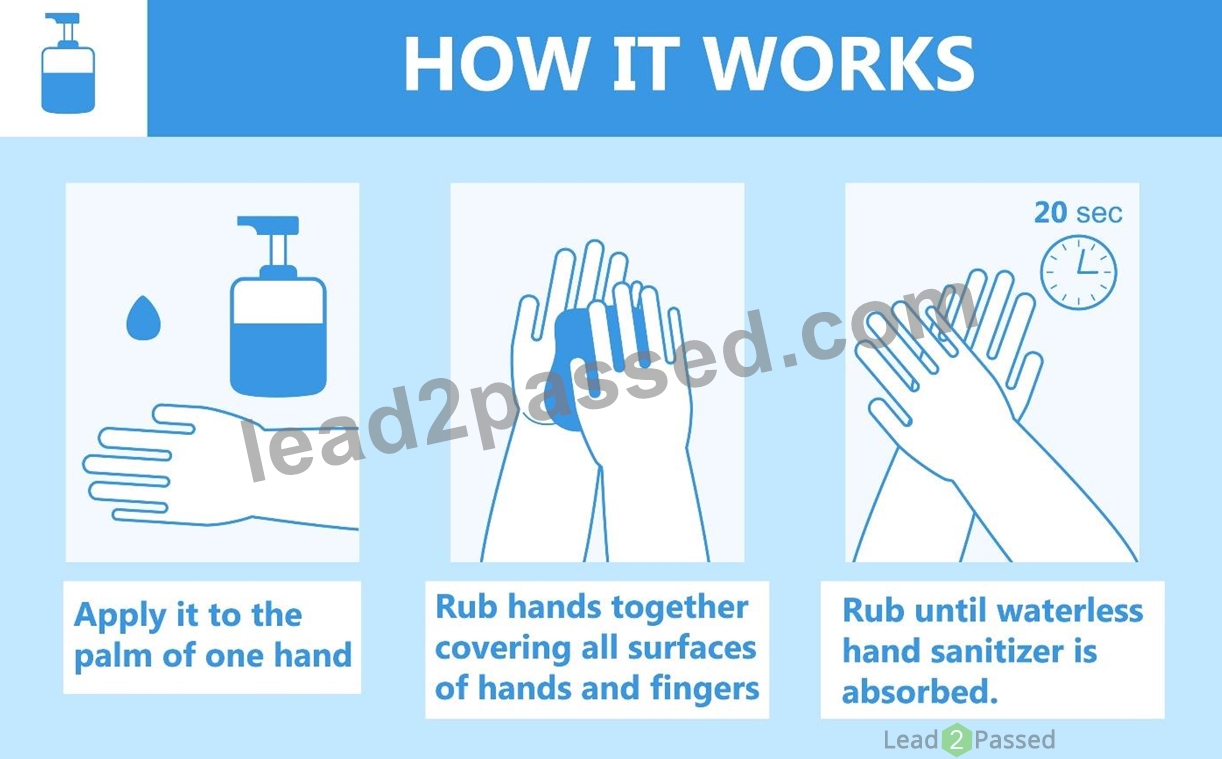
Shutterstock
The primary reason for this is that antiseptics are not effective at removing dirt, grease, or certain tough-to-kill pathogens likeNorovirusorHepatitis Aif the hands are soiled. Soap and water, combined with the mechanical friction of scrubbing, are required to physically lift and wash away these contaminants. An antiseptic used on dirty hands will simply be neutralized by the organic matter. Furthermore, the antiseptic used must be compliant with the FDA's "Code of Federal Regulations" for food contact. If an antiseptic is used, the food handler must allow it to completely air-dry before touching food or equipment to avoid chemical contamination. Using it before washing (Option B) is useless as the soap will wash it away, and using it instead of washing (Option A) is a major health code violation. Managers should view antiseptics as an "extra layer" of protection, but the core focus must always remain on rigorous, frequent handwashing at the appropriate times.
NEW QUESTION # 31
In general, pathogens grow very slowly or not at all at pH levels below
- A. 4.6.
- B. 6.0.
- C. 6.4.
- D. 5.0.
Answer: A
Explanation:
Bacteria require specific conditions to grow, often remembered by the acronymFAT TOM(Food, Acidity, Temperature, Time, Oxygen, Moisture). Acidity is measured on a pH scale from 0 to 14.0. Most foodborne pathogens grow best in food that is slightly acidic to neutral, typically between a pH of 4.6 and 7.5. ServSafe and the FDA Food Code identify4.6as the critical "cutoff" point for safety.
When the pH level of a food is below 4.6 (highly acidic), it creates an environment that is too hostile for most pathogenic bacteria, such asClostridium botulinum, to grow and produce toxins. This is why highly acidic foods like lemons, limes, and many vinegars are generally not considered TCS foods. In food preservation, such as pickling or fermenting, the goal is often to lower the pH of the food below this 4.6 threshold to make it shelf-stable. Conversely, foods with a pH above 4.6, such as meat, milk, and most vegetables, require strict time and temperature control because their low acidity allows for rapid bacterial multiplication. Managers must be aware of the pH of the items they serve, especially when dealing with specialized processes like
"reduced oxygen packaging" (ROP) or acidified rice for sushi, where maintaining a safe pH is a critical control point.
NEW QUESTION # 32
There has been a recall of chicken tenders due to intentional tampering. The Person in Charge (PIC) has determined that the operation serves the type of chicken tenders recalled. What should the PIC do?
- A. Tell food handlers to cook the tenders longer.
- B. Continue serving, since the probability of having received tainted food is slim.
- C. Donate all of the chicken tenders to a local food bank.
- D. Immediately locate and isolate all of the chicken tenders and call the regulatory authority.
Answer: D
Explanation:
Intentional tampering is a "food defense" issue and represents a critical threat to public safety. Unlike accidental biological contamination, intentional tampering may involve chemical, physical, or biological agents that are not necessarily destroyed by heat. Therefore, telling staff to cook the food longer (Option A) is an ineffective and dangerous response. According to ServSafe guidelines for managing recalls, especially those involving a security threat, the PIC must immediately take t1he product out of service by locating and isolating it.
The isolated food must be clearly labeled with "Do Not Use" and "Do Not Discard" signs to prevent any accidental preparation. It should be stored in a separate area from all other food and equipment. Furthermore, because this recall involves "intentional tampering," the PIC must notify the local regulatory authority (health department) and potentially law enforcement. This ensures that the incident is tracked and that the source of the tampering can be investigated. Continuing to serve the food (Option B) is gross negligence. Donating the food (Option D) is unethical and illegal, as it passes a known hazard to another population. This procedure is a key part of theA.L.E.R.T.food defense program, specifically the "Report" and "Threat" components, which emphasize transparency and cooperation with health officials during a crisis.
NEW QUESTION # 33
Customers experiencing allergic reactions often show which symptom?
- A. Fever
- B. Jaundice
- C. Hives
- D. Sneezing
Answer: C
Explanation:
Image of allergic reaction symptoms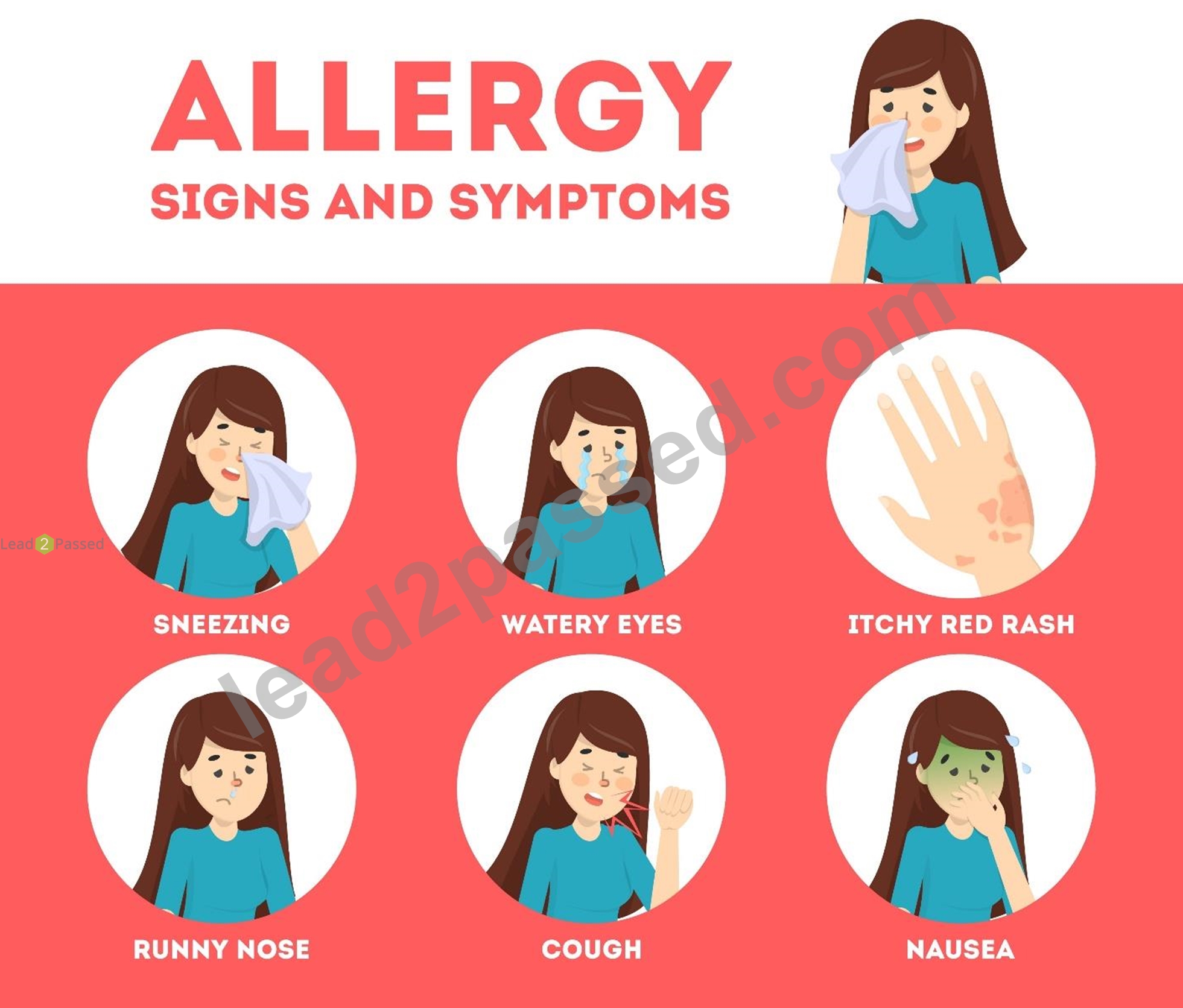
Shutterstock
Food allergies are an immune system response to specific proteins in food. While symptoms can vary significantly between individuals,hives(urticaria)-which are itchy, raised red welts on the skin-are one of the most common and recognizable signs of an allergic reaction. Other typical symptoms include swelling of the face, lips, or tongue (angioedema), abdominal cramps, vomiting, and shortness of breath. In the most severe cases, a customer may experience anaphylaxis, a life-threatening condition that can cause the throat to close and blood pressure to drop.
It is crucial for food handlers to distinguish allergy symptoms from foodborne illness symptoms. Fever (Option A) is usually a sign of an infection (biological contamination). Jaundice (Option B), a yellowing of the skin and eyes, is a specific symptom ofHepatitis A, which requires the exclusion of the employee from the facility. Sneezing (Option D) is generally associated with respiratory issues or seasonal allergies, rather than food allergies. When a guest notifies staff of an allergy, the manager must ensure that "cross-contact" is prevented by using clean and sanitized equipment and preparing the meal separately. If a guest begins showing symptoms like hives shortly after eating, the manager should call emergency services immediately, as the reaction can escalate rapidly. Training staff to recognize these signs is a key component of the
"Providing Safe Food" domain.
NEW QUESTION # 34
The floors, walls, ceiling, shelves, and racks in a walk-in refrigerator must be cleaned
- A. as needed.
- B. daily.
- C. weekly.
- D. monthly.
Answer: A
Explanation:
While food-contact surfaces must be cleaned and sanitized every four hours, non-food-contact surfaces-such as the structural elements of a walk-in refrigerator-follow a different standard. According to the FDA Food Code and the ServSafe Manager curriculum, these areas must be cleanedas neededto prevent the accumulation of dust, dirt, food particles, and mold. This "as needed" frequency means that the manager must monitor the condition of the walk-in and schedule cleaning before soil buildup becomes a hazard or attracts pests.
Cleaning "as needed" ensures that spills are addressed immediately to prevent the growth ofListeria monocytogenes, a pathogen that specifically thrives in cold, damp environments like walk-in coolers. If a leak or spill occurs, it must be cleaned right away, regardless of the schedule. However, for general maintenance, these areas should also be included on theMaster Cleaning Schedule. While some establishments may choose to do a deep clean weekly (Option B) or monthly (Option C), the regulatory requirement is flexible to accommodate the specific volume and usage of the operation. The key is that the surfaces must remain smooth, non-absorbent, and visibly clean. Dirty floors or moldy racks in a walk-in can lead to cross- contamination via the hands of food handlers or by dripping onto food stored below. Managers should conduct regular inspections to verify that "as needed" cleaning is being performed effectively to maintain a sanitary storage environment.
NEW QUESTION # 35
Which plant food must be transported to the serving site at $41^{\circ}F$ ($5^{\circ}C$) or below?
- A. Chopped celery
- B. Sliced cucumbers
- C. Diced tomatoes
Answer: C
Explanation:
The FDA Food Code identifies certain produce items as TCS (Time/Temperature Control for Safety) foods once they have been "processed" or cut.Diced tomatoesare specifically classified as a TCS food. While a whole tomato is shelf-stable, slicing or dicing it breaks the protective outer skin and allows pathogens that may have been on the surface to enter the nutrient-rich, moist interior. Tomatoes also have a neutral pH that supports the rapid growth of bacteria likeSalmonella. Therefore, they must be maintained and transported at
$41^{\circ}F$ ($5^{\circ}C$) or lower.
Chopped celery (Option A) and sliced cucumbers (Option C) are currently not classified as TCS foods by the FDA, although they should still be handled with good hygiene and refrigerated for quality. Other plant foods that require $41^{\circ}F$ control include cut leafy greens, cut melons, and sprouts. When transporting diced tomatoes, the manager must use refrigerated trucks or insulated containers with ice packs to ensure the temperature does not rise into the Danger Zone. This is a critical point for salad bars and catering operations where pre-cut produce is common. Failure to maintain temperature control for cut tomatoes has been linked to numerous large-scale foodborne illness outbreaks.
NEW QUESTION # 36
If chemicals are transferred to secondary containers, the secondary containers must be labeled with the chemical's
- A. expiration date.
- B. Safety Data Sheet (SDS).
- C. common name.
- D. usage instructions.
Answer: C
Explanation:
In a professional kitchen, chemicals such as cleaners, degreasers, and sanitizers are often purchased in bulk (large carboys or drums) and then transferred to smaller, more manageable spray bottles or buckets for daily use. These smaller vessels are known as "secondary containers." According to ServSafe and OSHA (Occupational Safety and Health Administration) standards, these containersmust be labeled with the chemical's common name.
This labeling is critical for two reasons. First, it prevents the accidental misuse of a chemical (for example, mistaking a powerful degreaser for a mild glass cleaner). Second, and most importantly, it prevents the catastrophic error of a chemical being mistaken for a food ingredient. A spray bottle containing a clear sanitizer could easily be confused with water or white vinegar if it is not clearly labeled. While usage instructions (Option C) are helpful, the "common name" is the mandatory requirement. The Safety Data Sheet (Option D) must be kept on file in the facility for every chemical used, but the sheet itself does not need to be attached to the bottle. Expiration dates (Option A) are rarely required on secondary labels unless specified by the manufacturer. Managers must ensure that labels are durable, legible, and written in English (and potentially other languages spoken by the staff). This is a vital part of "Chemical Contamination" prevention and "Cleaning and Sanitizing" management.
NEW QUESTION # 37
Eggs should not be pooled for high-risk populations because pooling
- A. can cause the chemistry of the eggs to change.
- B. makes the eggs difficult to portion.
- C. increases the risk of bacterial growth and contamination.
- D. might allow shells to be mixed in.
Answer: C
Explanation:
"Pooling" refers to the practice of breaking multiple eggs into a single bowl or container for later use, such as for making large batches of scrambled eggs or omelets. While this is a common time-saving technique in commercial kitchens, it carries a significant risk ofcross-contamination. According to ServSafe, if one egg in the pool is contaminated withSalmonella Enteritidis, the entire batch becomes contaminated. In a "pool," the bacteria have more moisture and nutrients to multiply, and the risk is spread across all servings made from that batch.1 ForHigh-Risk Populations (HSP)-which include the elderly, preschool-age children, and people with compromised immune systems-this risk2is unacceptable. These individuals are more likely to suffer severe illness or death from foodborne pathogens. Therefore, the FDA Food Code mandates that establishments serving these populations must usepasteurized eggswhen pooling is necessary, or they must crack eggs fresh for each individual serving. Pasteurized eggs have been heat-treated to kill pathogens likeSalmonellawithout cooking the egg itself. For general populations, pooling is allowed if the eggs are used immediately or stored at $41^{\circ}F$ ($5^{\circ}C$) or lower and cooked thoroughly. However, in the context of HSPs, the avoidance of pooled raw eggs is a critical control measure to prevent a potential outbreak.
NEW QUESTION # 38
Time as a food safety control is used to hold a time/temperature control for safety (TCS) food at room temperature. It is marked with a start time of 4 p.m. By 8 p.m. it was not sold or served. What should the food handler do with the food?
- A. Throw it out.
- B. Serve it immediately.
- C. Cool and store it immediately.
- D. Increase heat and serve it.
Answer: A
Explanation:
The FDA Food Code allows for "Time as a Public Health Control" (TPHC), where TCS food can be held without temperature control for a limited window. For food starting at $135^{\circ}F$ ($57^{\circ}C$) or higher, the maximum allowable time is4 hours. The food must be clearly marked with the time it was removed from temperature control and the time it must be discarded. In this scenario, the food was removed at
4 p.m., making the "discard time" 8 p.m. Once that 4-hour limit is reached, any remaining foodmust be thrown out.
The logic behind this rule is that after 4 hours in the "Temperature Danger Zone," bacteria may have multiplied to levels that can cause illness, or they may have produced heat-stable toxins that cannot be destroyed by reheating. Therefore, increasing the heat (Option C) or serving it "immediately" after the deadline (Option B) is unsafe. Additionally, the food cannot be returned to the refrigerator or freezer (Option D); once it is designated for TPHC, it is on a "one-way trip" to either being consumed or discarded. For cold food, the limit can sometimes be extended to 6 hours if the food temperature never exceeds $70^{\circ}F$ ($21^{\circ}C$), but for standard hot-to-room-temperature service, the 4-hour limit is absolute. Managers must ensure that staff strictly monitor these labels and never attempt to "extend" the time by changing the sticker.
NEW QUESTION # 39
How many days can refrigerated, ready-to-eat time/temperature control for safety (TCS) foods be stored safely at $41^{\circ}F$ ($5^{\circ}C$)?
- A. 0
- B. 1
- C. 2
- D. 3
Answer: A
Explanation:
Date marking is a critical safety protocol for ready-to-eat (RTE) TCS foods that are prepared on-site and held for more than 24 hours. According to ServSafe and the FDA Food Code, these foods can be stored for a maximum of7 daysif they are maintained at an internal temperature of $41^{\circ}F$ ($5^{\circ}C$) or lower. The count begins on the day the food was prepared or the day a commercial container was opened. For example, if a large batch of potato salad is made on October 1st, its "use-by" date would be October 7th. This seven-day limit is based on the growth rate ofListeria monocytogenes, a dangerous pathogen that can grow at refrigeration temperatures. While it grows slowly at $41^{\circ}F$, after seven days, its population can reach levels high enough to cause serious illness, particularly in high-risk populations.
Proper labeling must include the name of the food and the clear use-by or discard date. If a food item contains multiple ingredients with different discard dates (for example, a wrap made with turkey that expires on the 5th and cheese that expires on the 7th), the entire dish must be discarded on theearliestdate (the 5th). Managers must implement a "First In, First Out" (FIFO) system and conduct daily checks of refrigerated units to ensure that any food exceeding the seven-day limit is discarded immediately. This protocol is an essential "Active Managerial Control" to prevent the service of compromised food. Failure to properly date-mark is one of the most common violations found during health inspections because it removes the only objective way to track the safety and age of prepared foods.
NEW QUESTION # 40
When sanitizing utensils using hot water in a three-compartment sink, the temperature of the hot water must be at least
- A. $171^{\circ}F$ ($77^{\circ}C$).
- B. $165^{\circ}F$ ($74^{\circ}C$).
- C. $110^{\circ}F$ ($43^{\circ}C$).
- D. $180^{\circ}F$ ($82^{\circ}C$).
Answer: A
Explanation:
If an operation chooses to use heat instead of chemicals to sanitize utensils in a three-compartment sink, specific temperature requirements must be met to ensure the destruction of pathogens. According to the FDA Food Code and ServSafe, the water in the third (sanitizing) compartment must be at least$171^{\circ}F$ ($77^{\circ}C$). Additionally, the items being sanitized must be completely immersed in this hot water for a minimum of30 seconds.
Maintaining this temperature is challenging in a manual sink and typically requires a heating element or
"booster" to keep the water consistently hot. If the water drops below $171^{\circ}F$, it is no longer considered a reliable sanitizer. For comparison, $110^{\circ}F$ (Option A) is the minimum temperature for thewash(first) sink. $180^{\circ}F$ (Option D) is the temperature required for the final sanitizing rinse in a stationary rack, single-temperature machine or a high-temperature conveyor machine. Using heat-based sanitizing requires the manager to provide staff with a way to verify the temperature, such as a waterproof thermometer or heat-sensitive tape. This method is effective but requires strict monitoring to prevent staff from being burned and to ensure the 30-second immersion time is strictly followed.
NEW QUESTION # 41
Which of the following is evidence of deliberate tampering of food?
- A. Labels are missing from food containers.
- B. Sulfites are added to prevent browning of lettuce.
- C. Food employees are handling ready-to-eat foods with bare hands.
- D. Protective seal or wrapper is missing from a food container.
Answer: D
Explanation:
Food defense is the protection of food products from intentional contamination by biological, chemical, physical, or radiological agents. While "accidental" contamination (like a hair in a soup) is common,
"deliberate tampering" is an act of sabotage. According to the ServSafe Manager guidelines and the FDA'sA.
L.E.R.T.program, one of the most visible signs of tampering is amissing or broken protective seal or wrapperon a food container. These seals are designed to guarantee the integrity of the product from the manufacturer to the end-user. If a seal is broken, it suggests that an unauthorized individual may have had access to the contents.
Managers must train receiving staff to inspect all incoming deliveries specifically for signs of tampering. This includes checking for punctured packaging, leaking containers, or boxes that appear to have been resealed with non-factory tape. While missing labels (Option A) are a regulatory violation and bare-hand contact (Option D) is a hygiene failure, they do not necessarily indicate a malicious attempt to harm the public.
Adding sulfites (Option B) is actually a prohibited practice for fresh produce in many jurisdictions, but it is a chemical additive issue rather than tampering. To mitigate the risk of deliberate contamination, the A.L.E.R.
T. system suggests that managers:Assure products are from safe sources,Look and monitor the security of the facility,Employees (know who is in the building),Report and keep records, andThreat (know what to do if a threat occurs). Isolating and reporting any products with suspicious packaging is a mandatory step in protecting the business and its customers from intentional harm.
NEW QUESTION # 42
When receiving fresh meat, its temperature at the time of receipt must not be higher than
- A. $70^{\circ}F$ ($21^{\circ}C$).
- B. $41^{\circ}F$ ($5^{\circ}C$).
- C. $32^{\circ}F$ ($0^{\circ}C$).
- D. $55^{\circ}F$ ($13^{\circ}C$).
Answer: B
Explanation:
In the "Flow of Food," receiving is the first line of defense against foodborne illness. According to the ServSafe Manager curriculum and the FDA Food Code, all cold Time/Temperature Control for Safety (TCS) foods-including fresh meat, poultry, and seafood-must be received at an internal temperature of$41^{\circ} F$ ($5^{\circ}C$) or lower. This temperature is the upper limit of the safe cold-holding zone. Receiving meat above this temperature indicates that it has been subjected to time-temperature abuse during transport, which allows for the rapid multiplication of pathogens such asSalmonellaandE. coli.
When a delivery arrives, the Person in Charge (PIC) or a designated receiver must use a calibrated bimetallic stemmed thermometer or a thermocouple to check the internal temperature of the product. For meat and poultry, the probe should be inserted into the thickest part of the product. If the temperature exceeds $41^
{\circ}F$, the shipment should be rejected and the incident documented in a receiving log. This practice is a critical component of Active Managerial Control, ensuring that only safe, high-quality ingredients enter the kitchen. While some items like shell eggs or milk have slightly higher receiving temperature allowances ($45^
{\circ}F$), fresh meat must strictly adhere to the $41^{\circ}F$ standard. Maintaining the "cold chain" from the supplier to the refrigerator is essential for preventing the growth of microorganisms and extending the shelf life of the product.
NEW QUESTION # 43
A server finds a full napkin-lined basket of dinner rolls on a table after a customer has left the establishment. According to the FDA Food Code, what should the server do with the rolls and napkin?
- A. Replace the napkin and donate the unused rolls to charity.
- B. Reuse the napkin but replace the rolls with fresh ones.
- C. Replace the napkin and give the unused rolls to employees for staff meal.
- D. Remove the napkin and discard the rolls.
Answer: D
Explanation:
The FDA Food Code is very clear regarding the re-service of food. Once food has been served to a guest, it is considered "potentially contaminated" and cannot be served to another guest, donated, or given to staff.
Therefore, the server mustdiscard the rolls. Even if the rolls appear untouched, they have been exposed to the guest's environment, where they may have been coughed on, sneezed on, or touched with unwashed hands.
The only exceptions to this "no re-service" rule are foods that are packaged and in good condition, such as unopened cracker packets, individual condiment packets (like ketchup or mustard), or wrapped "saltine" crackers. Rolls in an open basket do not meet this criteria. Regarding the napkin, if it is a cloth napkin, it must be sent to the laundry. If it is a paper napkin, it must be discarded. Reusing any part of the service (Option B) or donating contaminated food (Option C) poses a significant risk of spreading foodborne illness, specifically StovirusorStaphylococcus aureus. Managers must train front-of-house staff to never "recycle" bread, butter, or garnishes that have been placed on a customer's table. This protocol ensures that every guest receives food that is fresh and has not been subjected to previous human contact.
NEW QUESTION # 44
A food establishment must have specific procedures for employees to follow when cleaning up which of the following substances?
- A. Mold and mildew
- B. Food spills and beverage machine leaks
- C. Vomit and diarrhea
- D. Rodent droppings and dead cockroaches
Answer: C
Explanation:
According to the FDA Food Code and the ServSafe Manager curriculum, every food establishment is required to have a formal, written plan for the cleanup ofvomit and diarrhea. This requirement ex1ists because these substan2ces are primary vehicles3for the transmission ofNorovirus, which is highly contagious and the leading cause of foodborne illness in the United States. Norovirus can be aerosolized (spread through the air) when a person vomits, and it can survive on surfaces for weeks if not properly disinfected.
The written procedures must detail how employees will minimize the spread of contamination to food, surfaces, and other people. This typically involves using a "Body Fluid Cleanup Kit" that includes personal protective equipment (PPE) such as disposable gloves, a gown, and a face mask. The cleanup process requires the use of a high-concentration disinfectant (such as a 1,000-5,000 ppm chlorine solution) rather than standard kitchen sanitizers, which are often too weak to kill Norovirus. The plan must also specify how to dispose of contaminated materials and how to handle the "exclusion" of the sick individual. While cleaning mold (Option A), spills (Option C), or pest evidence (Option D) is important for general sanitation, the legal mandate for aspecific written procedureis focused on Norovirus containment to prevent massive outbreaks.
Managers are responsible for training all staff on these protocols before an incident occurs.
NEW QUESTION # 45
When an operation is notified of a food item recall, what is the best action for the Person in Charge (PIC) to take?
- A. Separate recalled food from other food and equipment.
- B. Close the operation immediately.
- C. Post a sign in the operation warning customers of the recall.
- D. Report the recall to the FDA.
Answer: A
Explanation:
A food recall happens when a manufacturer or a government agency (FDA or USDA) determines that a product is unsafe due to contamination, undeclared allergens, or mislabeling. Once a manager is notified of a recall, the immediate priority is to prevent the product from reaching the consumer. According to the ServSafe Manager protocol, the PIC mustseparate the recalled food from all other food, equipment, utensils, linens, and single-service items.
The recalled product should be clearly labeled "Do Not Use" and "Do Not Discard" to prevent it from being accidentally prepared or thrown away before the recall process is finalized. It is best to store it in a designated, secure area away from the regular Flow of Food. Reporting the recall to the FD3A (Option A) is typically unnecessary as the FDA usual4ly initiates or is already aware of the recall. Closing the operation (Option B) is only required if the recalled item was so pervasive that the entire facility is contaminated or if it caused an imminent health hazard. Posting a sign (Option D) might be required by local law in some cases, but the
"best" immediate safety action is the physical isolation of the product. The PIC should then follow the specific instructions provided in the recall notice, which may involve returning the product for credit or disposing of it in a manner that ensures it cannot be consumed.
NEW QUESTION # 46
......
Dumps of ServSafe-Manager Cover all the requirements of the Real Exam: https://examsdocs.lead2passed.com/ServSafe/ServSafe-Manager-practice-exam-dumps.html