100% Free Microsoft Certified DP-600 Dumps PDF Demo Cert Guide Cover
PDF Exam Material 2026 Realistic DP-600 Dumps Questions
Microsoft DP-600 Exam Syllabus Topics:
| Topic | Details |
|---|---|
| Topic 1 |
|
| Topic 2 |
|
| Topic 3 |
|
NEW QUESTION # 18
You have a Fabric tenant that contains a lakehouse named lakehouse1. Lakehouse1 contains an unpartitioned table named Table1.
You plan to copy data to Table1 and partition the table based on a date column in the source data.
You create a Copy activity to copy the data to Table1.
You need to specify the partition column in the Destination settings of the Copy activity.
What should you do first?
- A. From the Destination tab, set Mode to Overwrite.
- B. From the Destination tab, set Mode to Append.
- C. From the Source tab, select Enable partition discovery
- D. From the Destination tab, select the partition column,
Answer: A
Explanation:
Before specifying the partition column in the Destination settings of the Copy activity, you should set Mode to Append (A). This will allow the Copy activity to add data to the table while taking the partition column into account. Reference = The configuration options for Copy activities and partitioning in Azure Data Factory, which are applicable to Fabric dataflows, are outlined in the official Azure Data Factory documentation.
NEW QUESTION # 19
You have a Fabric tenant that contains a workspace named Workspace1. Workspace1 contains a single semantic model that has two Microsoft Power BI reports.
You have a Microsoft 365 subscription that contains a data loss prevention (DLP) policy named DLP1.
You need to apply DLP1 to the items in Workspace1.
What should you do?
- A. Apply a master data endorsement to the semantic model.
- B. Apply a certified endorsement to the semantic model.
- C. Apply sensitivity labels to the semantic model and reports.
- D. Create a workspace identity.
Answer: C
NEW QUESTION # 20
You need to design a semantic model for the customer satisfaction report.
Which data source authentication method and mode should you use? To answer, select the appropriate options in the answer area.
NOTE: Each correct selection is worth one point.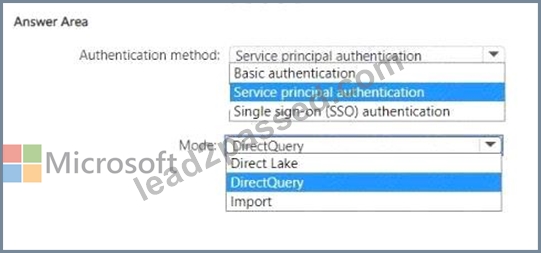
Answer:
Explanation:
Explanation: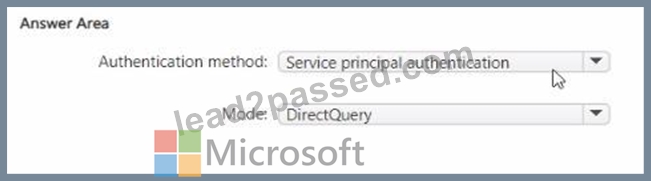
For the semantic model design required for the customer satisfaction report, the choices for data source authentication method and mode should be made based on security and performance considerations as per the case study provided.
Authentication method: The data should be accessed securely, and given that row-level security (RLS) is required for users executing T-SQL queries, you should use an authentication method that supports RLS.
Service principal authentication is suitable for automated and secure access to the data, especially when the access needs to be controlled programmatically and is not tied to a specific user's credentials.
Mode: The report needs to show data as soon as it is updated in the data store, and it should only contain data from the current and previous year. DirectQuery mode allows for real-time reporting without importing data into the model, thus meeting the need for up-to-date data. It also allows for RLS to be implemented and enforced at the data source level, providing the necessary security measures.
Based on these considerations, the selections should be:
* Authentication method: Service principal authentication
* Mode: DirectQuery
NEW QUESTION # 21
You have a Microsoft Fabric tenant that contains a dataflow.
You are exploring a new semantic model.
From Power Query, you need to view column information as shown in the following exhibit.
Which three Data view options should you select? Each correct answer presents part of the solution. NOTE:
Each correct answer is worth one point.
- A. Show column quality details
- B. Show column profile in details pane
- C. Enable column profile
- D. Enable details pane
- E. Show column value distribution
Answer: A,C,E
Explanation:
To view column information like the one shown in the exhibit in Power Query, you need to select the options that enable profiling and display quality and distribution details. These are: A. Enable column profile - This option turns on profiling for each column, showing statistics such as distinct and unique values. B. Show column quality details - It displays the column quality bar on top of each column showing the percentage of valid, error, and empty values. E. Show column value distribution - It enables the histogram display of value distribution for each column, which visualizes how often each value occurs.
References: These features and their descriptions are typically found in the Power Query documentation, under the section for data profiling and quality features.
NEW QUESTION # 22
You have a Microsoft Power Bl semantic model.
You plan to implement calculation groups.
You need to create a calculation item that will change the context from the selected date to month-to-date (MTD).
How should you complete the DAX expression? To answer, select the appropriate options in the answer area.
NOTE: Each correct selection is worth one point.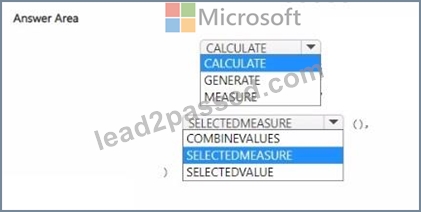
Answer:
Explanation:
NEW QUESTION # 23
You have a Fabric tenant that contains a machine learning model registered in a Fabric workspace.
You need to use the model to generate predictions by using the PREDICT function in a Fabric notebook.
Which two languages can you use to perform model scoring? Each correct answer presents a complete solution.
NOTE: Each correct answer is worth one point.
- A. DAX
- B. Spark SQL
- C. PySpark
- D. T-SQL
Answer: B,C
Explanation:
https://learn.microsoft.com/en-us/azure/synapse-analytics/machine-learning/tutorial-score-model- predict-spark-pool
NEW QUESTION # 24
You need to create a data loading pattern for a Type 1 slowly changing dimension (SCD).
Which two actions should you include in the process? Each correct answer presents part of the solution.
NOTE: Each correct answer is worth one point.
- A. Update rows when the non-key attributes have changed.
- B. Update the effective end date of rows when the non-key attribute values have changed.
- C. Insert new rows when the natural key exists in the dimension table, and the non-key attribute values have changed.
- D. Insert new records when the natural key is a new value in the table.
Answer: A,D
Explanation:
For a Type 1 SCD, you should include actions that update rows when non-key attributes have changed (A), and insert new records when the natural key is a new value in the table (D). A Type 1 SCD does not track historical data, so you always overwrite the old data with the new data for a given key. References = Details on Type 1 slowly changing dimension patterns can be found in data warehousing literature and Microsoft's official documentation.
NEW QUESTION # 25
You have a Fabric tenant that contains a semantic model. The model contains data about retail stores.
You need to write a DAX query that will be executed by using the XMLA endpoint The query must return a table of stores that have opened since December 1,2023.
How should you complete the DAX expression? To answer, drag the appropriate values to the correct targets.
Each value may be used once, more than once, or not at all. You may need to drag the split bar between panes or scroll to view content.
NOTE: Each correct selection is worth one point.
Answer:
Explanation:
Explanation:
The correct order for the DAX expression would be:
* DEFINE VAR _SalesSince = DATE ( 2023, 12, 01 )
* EVALUATE
* FILTER (
* SUMMARIZE ( Store, Store[Name], Store[OpenDate] ),
* Store[OpenDate] >= _SalesSince )
In this DAX query, you're defining a variable _SalesSince to hold the date from which you want to filter the stores. EVALUATE starts the definition of the query. The FILTER function is used to return a table that filters another table or expression. SUMMARIZE creates a summary table for the stores, including the Store[Name] and Store[OpenDate] columns, and the filter expression Store[OpenDate] >= _SalesSince ensures only stores opened on or after December 1, 2023, are included in the results.
References =
* DAX FILTER Function
* DAX SUMMARIZE Function
NEW QUESTION # 26
You have source data in a CSV file that has the following fields:
* SalesTra nsactionl D
* SaleDate
* CustomerCode
* CustomerName
* CustomerAddress
* ProductCode
* ProductName
* Quantity
* UnitPrice
You plan to implement a star schema for the tables in WH1. Thedimension tables in WH1 will implement Type 2 slowly changing dimension (SCD) logic.
You need to design the tables that will be used for sales transaction analysis and load the source data.
Which type of target table should you specify for the CustomerName, CustomerCode, and SaleDate fields?
To answer, select the appropriate options in the answer area.
NOTE: Each correct selection is worth one point.
Answer:
Explanation:
Explanation:
NEW QUESTION # 27
Hotspot Question
You have a Fabric tenant that contains a PySpark notebook named Notebook1.
You define sas_token as a variable in the first cell of Notebook1 and store a shared access signature (SAS) token in the variable.
In the second cell, you run the following code.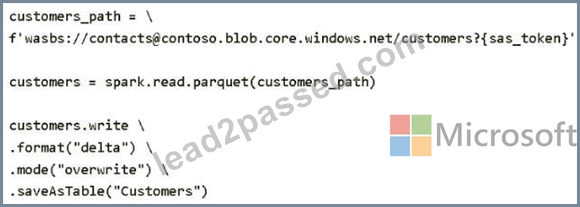
For each of the following statements, select Yes if the statement is true. Otherwise, select No.
NOTE: Each correct selection is worth one point.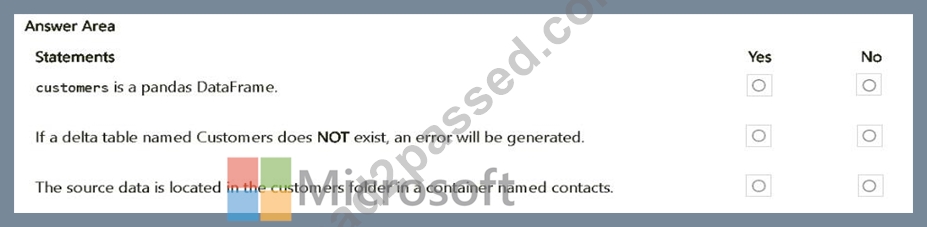
Answer:
Explanation:
NEW QUESTION # 28
You have a Fabric tenant that contains a lakehouse named Lakehouse1. Lakehouse1 contains a table named Nyctaxi_raw. Nyctaxi_raw contains the following columns.
You create a Fabric notebook and attach it to lakehouse1.
You need to use PySpark code to transform the dat
a. The solution must meet the following requirements:
* Add a column named pickupDate that will contain only the date portion of pickupDateTime.
* Filter the DataFrame to include only rows where fareAmount is a positive number that is less than 100.
How should you complete the code? To answer, select the appropriate options in the answer area. NOTE: Each correct selection is worth one point.
Answer:
Explanation:
NEW QUESTION # 29
Hotspot Question
You have a Fabric warehouse that contains a table named Sales.Orders. Sales.Orders contains the following columns.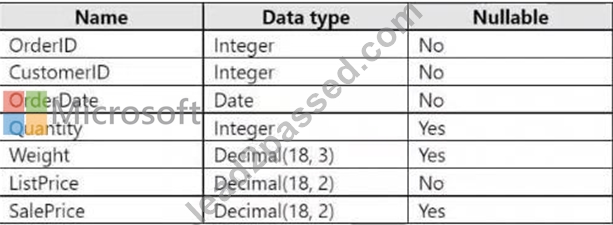
You need to write a T-SQL query that will return the following columns.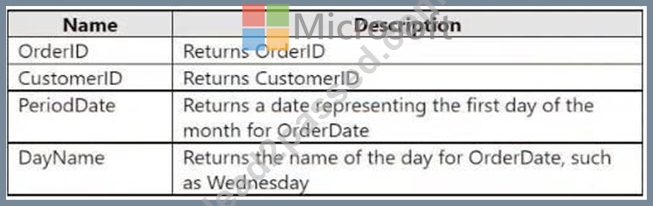
How should you complete the code? To answer, select the appropriate options in the answer area.
NOTE: Each correct answer is worth one point.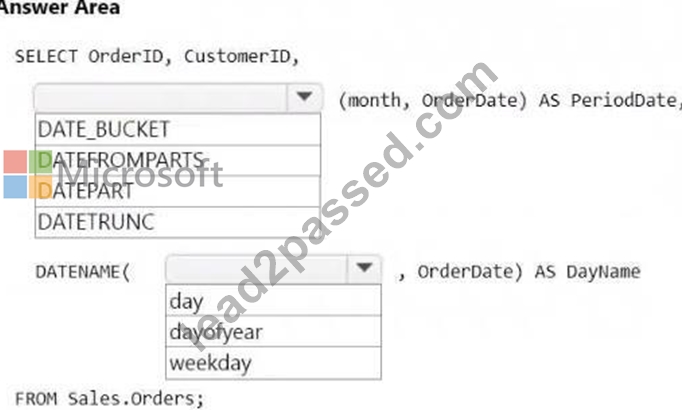
Answer:
Explanation: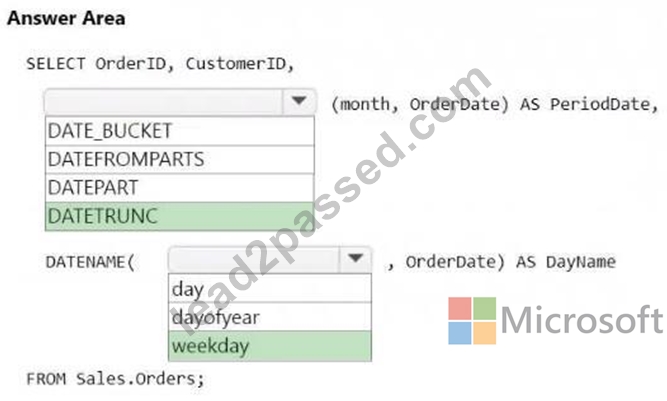
Explanation:
https://learn.microsoft.com/en-us/sql/t-sql/functions/datetrunc-transact-sql?view=sql-server-ver16
https://learn.microsoft.com/en-us/sql/t-sql/functions/datename-transact-sql?view=sql-server-ver16
NEW QUESTION # 30
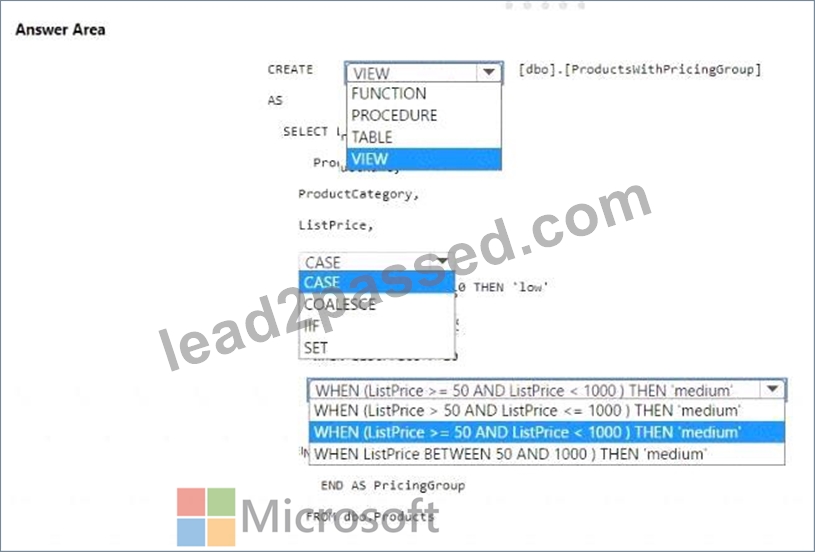
You need to resolve the issue with the pricing group classification.
How should you complete the T-SQL statement? To answer, select the appropriate options in the answer area.
NOTE: Each correct selection is worth one point.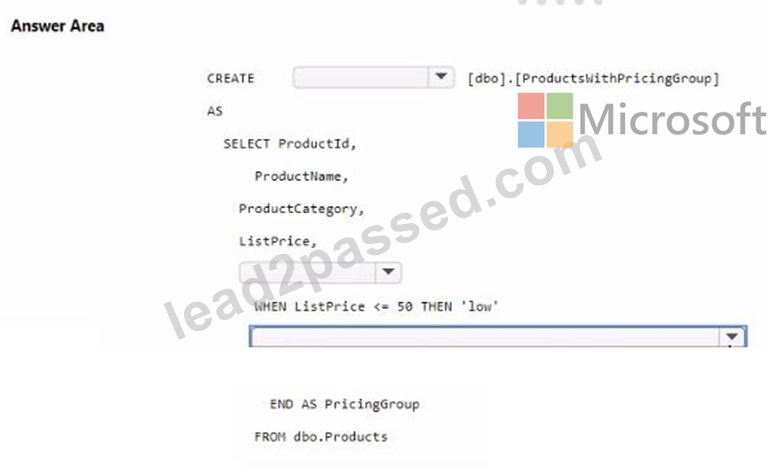
Answer:
Explanation:
Explanation:
* You should use CREATE VIEW to make the pricing group logic available for T-SQL queries.
* The CASE statement should be used to determine the pricing group based on the list price.
The T-SQL statement should create a view that classifies products into pricing groups based on the list price.
The CASE statement is the correct conditional logic to assign each product to the appropriate pricing group.
This view will standardize the pricing group logic across different databases and semantic models.
NEW QUESTION # 31
You need to create a data loading pattern for a Type 1 slowly changing dimension (SCD).
Which two actions should you include in the process? Each correct answer presents part of the solution.
NOTE: Each correct answer is worth one point.
- A. Update rows when the non-key attributes have changed.
- B. Update the effective end date of rows when the non-key attribute values have changed.
- C. Insert new rows when the natural key exists in the dimension table, and the non-key attribute values have changed.
- D. Insert new records when the natural key is a new value in the table.
Answer: A,D
Explanation:
Type 1 SCD does not preserve history, therefore no end dates for table entries exists.
NEW QUESTION # 32
Note: This question is part of a series of questions that present the same scenario. Each question in the series contains a unique solution that might meet the stated goals. Some question sets might have more than one correct solution, while others might not have a correct solution.
After you answer a question in this section, you will NOT be able to return to it. As a result, these questions will not appear in the review screen.
You have a Fabric tenant that contains a semantic model named Model1.
You discover that the following query performs slowly against Model1.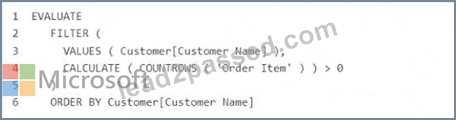
You need to reduce the execution time of the query.
Solution: You replace line 4 by using the following code:
Does this meet the goal?
- A. Yes
- B. No
Answer: A
NEW QUESTION # 33
......
Updated Microsoft DP-600 Dumps – PDF & Online Engine: https://examsdocs.lead2passed.com/Microsoft/DP-600-practice-exam-dumps.html